
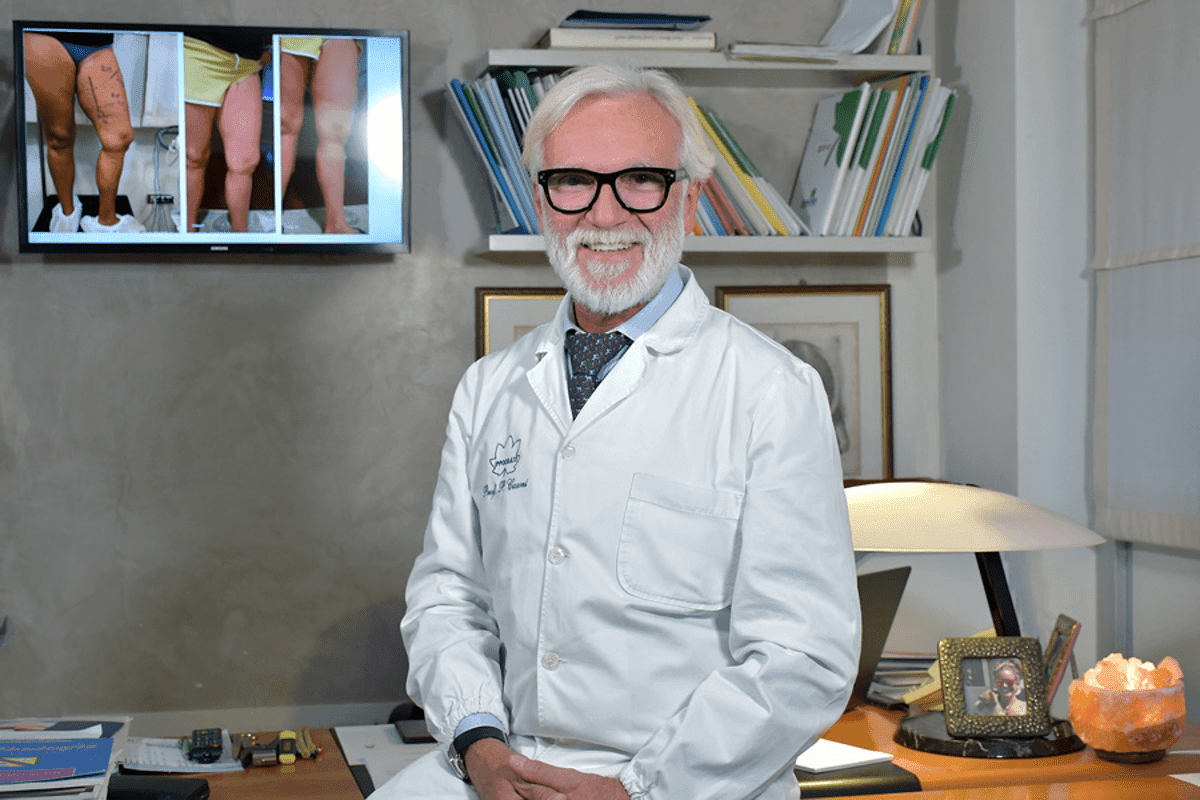
Treating varicose veins while respecting the body’s natural anatomy: this is the philosophy of Centro Medico Ippocrate in Parma, a leading Vein Academy headed by Dr. Paolo Casoni, a general, vascular and oncological surgeon with over forty years of experience. Here, the treatment of venous insufficiency moves beyond traditional surgical concepts, embracing an innovative approach based on minimally invasive techniques and the maximum preservation of the patient’s venous system.
Over the past fifty years, the approach to chronic venous disease has undergone a remarkable transformation. In the 1970s, traditional surgery relied on vein stripping, an invasive procedure performed under spinal anesthesia that required hospitalization, surgical incisions and removal of the saphenous vein. The beginning of the new millennium marked the transition to endovenous techniques. Thermal ablation using laser and radiofrequency, medical adhesives, foam sclerotherapy and mechanochemical systems made it possible to avoid skin incisions. However, despite reducing invasiveness, all these conventional methods share the same fundamental limitation: they work from inside the vessel to close or destroy it. When a vein is treated from within, the only possible outcome is its closure.
Today, Centro Ippocrate proposes a profound paradigm shift: moving from the destruction of veins to the preservation of the venous system. The new frontier in phlebology is represented by echotherapy using high-intensity focused ultrasound (HIFU), the first and only technology of its kind in clinical use in phlebology that allows treatment to be delivered entirely from the outside in, using the advanced Sonovein device. Dr. Casoni was among the world’s pioneers in adopting this technique, beginning in 2021, and published his first clinical and histological findings in the prestigious international journal Phlebology (2024).
But how does this technology work? HIFU is based on a fundamental principle of acoustic physics: high-intensity ultrasound waves are focused with extreme precision on a specific point beneath the skin, much like a magnifying glass concentrates sunlight. At the targeted point, the temperature rises for just a few moments, modifying the structure of the vein wall while leaving the overlying skin completely intact. Unlike any previous approach, HIFU energy first targets the outermost layers of the vascular wall. It is precisely this outside-in action that makes possible what was previously considered unattainable in medicine: narrowing a vein without closing it, reducing its diameter and eliminating reflux while keeping the vessel alive and fully functional.
According to Dr. Casoni’s scientific vision, this is the true key to the future of phlebology: moving beyond the traditional binary approach of deciding whether a vein should be “closed or left open” and instead determining how much it needs to be narrowed to restore proper function.
“For decades, we have eliminated diseased veins,” explains Dr. Casoni, “but today we can narrow them by working from the outside in. Our real clinical target is not the vein itself, but the excessive pressure inside it. It is not always necessary to eliminate a vessel; often, simply reducing its diameter is enough.”
From a hemodynamic perspective, reducing a vein’s diameter from, for example, 9 to 4 millimeters is sufficient to decrease the volume of stagnant blood by more than three quarters, restoring effective circulation.
The histological study conducted by the specialist scientifically demonstrated that the vein wall treated with HIFU undergoes a structural transformation into stable fibrous tissue which, rather than reopening over time, progressively consolidates and stabilizes over the years. Preserving a narrowed but still functioning vessel provides an invaluable reserve for the body: it maintains an essential drainage pathway for the leg and preserves a precious autologous “spare part” that could potentially be used in future cardiac or vascular bypass procedures.
When the patient’s anatomy requires it, the same Sonovein robotic system also offers the flexibility to completely close the vein or treat only a specific damaged segment.
The practical benefits of HIFU technology translate into a low-stress clinical experience with exceptionally high patient tolerability. The treatment is performed entirely on an outpatient basis and guided in real time by ultrasound imaging. No incisions are made, no needles or probes are inserted into the vein, and only minimal local skin anesthesia is required.
Once the session, which lasts just a few dozen minutes, is completed, there is no need for stitches or uncomfortable bandages. Patients can get off the treatment table, get dressed independently and walk home immediately, without any period of bed rest or recovery, returning straight to their normal daily and working activities.
The effectiveness and safety of the technique are supported by clinical data. A study involving 542 legs showed that, three years after treatment, 85% of treated veins were either completely closed or narrowed, with no evidence of reflux.
At Centro Ippocrate in Parma, where more than 650 limbs were treated between 2021 and 2025, no cases of deep vein thrombosis or pulmonary embolism were recorded. Furthermore, quality-of-life assessments using an internationally validated questionnaire showed significant improvements as early as six months after treatment.
HIFU Sonovein is a solution designed for elderly or frail patients, people receiving anticoagulant therapy who cannot or should not discontinue their medication, individuals who wish to avoid surgery, or anyone seeking treatment without disrupting their personal routines.
The therapeutic approach is always tailored to each individual patient, following a thorough specialist consultation and color Doppler ultrasound examination.
La Repubblica – Bologna – 15 ottobre 2026 – Salute Edizione Speciale
